Wednesday, September 22, 2010

American Idol

American Idol - Simon Cowell = 0

Thursday, September 9, 2010

WikiAnswers - What is the difference between a lake and loch in Scotland

A slightly different answer:

WikiAnswers - What is the difference between a lake and loch in Scotland: "My understanding is that the Lake of Menteith is the only 'lake' amongst over 3000 lochs. It was originally a swamp and was described as such at the time of the building of Inchmahome Priory on the island. The Gaelic word used was leagh meaning swampy place and this was corrupted to lake. So yes there is no difference !"

The difference between a Lake and a Loch?

The difference between a Lake and a Loch? in The AnswerBank: Environment: "Nothing to do with water in or out flow. Both lakes and lochs can have one or both. Loch is simply a word of gaelic derivation and describes a body of water in the same way the english word lake does. Lake of Menteith is supposedly an accident in naming due to confusion with the word laigh meaning low ground"

We were up by the Lake of Menteith yesterday.

Blair Understands Rational Ignorance

The Volokh Conspiracy � Tony Blair on Political Ignorance:
The single hardest thing for a practising politician to understand is that most people, most of the time, don’t give politics a first thought all day long. Or if they do, it is with a sigh...., before going back to worrying about the kids, the parents, the mortgage, the boss, their friends, their weight, their health, sex and rock ‘n’roll.....

For most normal people, politics is a distant, occasionally irritating fog. Failure to comprehend this is a fatal flaw in most politicians.

Saturday, September 4, 2010

Open-Shirt French Philosophers

This post is dedicate to Brett for saving all his old emails, and, more importantly, not switching email accounts in the last 4 years.

I can't remember exactly how all this happened, but at lunch yesterday, one of my coworkers started talking about French philosopher that he emulates when it comes to shirts. To his surprise, I instantly knew he was talking about Bernard Henri-Levy.

How did I know? Maybe it's because I'm only familiar with one living French philosopher. Or maybe, just maybe, it's because this co-worker has recently decided that he need not wear undershirts or fasten the top four buttons on his dress shirts. Consequently, his look is now a mix of hippy, libertine-swinger, and, most importantly--creepy old French guy. And when I think of creepy French guys, I immediately think of this article where Monsieur Levy deeply meditates on the philosophic implications of showing some chest:

I wake up at 5.30am. I have no problem getting out of bed. The first thing I need is a cup of tea, usually lapsang souchong. I dress as lightly as possible. I often wear a shirt open down to under my chest, but not out of vanity. The truth is, I find clothes suffocating. I want to live as much as possible in the open air, in the sun. I’ve never worn a tie in my life. That caused problems a couple of times: once at the Elysée Palace when I was invited to a lunch with the then president, Valéry Giscard d’Estaing, and once at the Vatican at a private audience with Pope John Paul II. I put my foot down both times. The Vatican let me not wear one on the spurious grounds I suffered from a serious handicap.

James Lileks wrote a parody I love, which I could not have found without Brett:
I awake, as is my preference. My waking had, as usual, the pleasant quality of surfacing from one world to another, with the gradual abandonment of one state for another, a trading of realms whose various attributes have merits in eternal opposition. In the sleeping state, one might be conversing with Descartes on an iceberg, while walruses provide hors d’oeuvres on the points of their tusks; in the real, physical state, one finds one has wet the bed again. But to wake is to be born, one thinks, and a certain amount of fluid is present in either case.
It's especially impressive considering the original material already reads like a parody.

Thursday, September 2, 2010

A Really, Really Hard Math Problem

Forty-five minutes is pretty long for a video about math, but I found this fascinating:


Update: I originally saw this on Cafe Hayek. He found it through this blog. Of course, the movie isn't about math, not really. It's about trying for the impossible and achieving it. It's also about human tragedy.

From Marginal Revolution:

Here is one of my all time favorite documentaries, the 45 minute Fermat's Last Theorem made by Simon Singh and John Lynch for the BBC in 1996. I've watched it many times and every time I am moved by unforgettable moments.

The plainspoken Goro Shimura talking of his friend Yutaka Taniyama, "he was not a very careful person as a mathematician, he made a lot of mistakes but he made mistakes in a good direction." "I tried to imitate him," he says sadly, "but I found out that it is very difficult to make good mistakes." Shimura continues to be troubled by his friend's suicide in 1958.


Monday, August 30, 2010

Cracks in the Plan

Anarchists are having problems raising money:

Dear Supporters of the Center for a Stateless Society,
I blame myself.

When we launched the month-plus long fundraising drive for combined July and August expenses two weeks ago, I tried to convey that because it was for two months worth of expenses (and that those particular months were ones with growing expenses), it was going to be a challenge.

I was right, but I should have been working harder to explain that, again and again, to you over the past two weeks.

Right now, the ChipIn fundraising meter shows only $489 (from only 8 donors) raised out of our goal of $4522. That’s 10% of our total goal raised with the drive almost 50% over with.

The irony here is that the anarchist plan for national defense in a stateless society is that people will voluntarily giving money to an non-government entity.

Sunday, August 29, 2010

Sunday Appropriate Blogging

1. A blog I regularly read linked to, what I though was a Mormon article about the mountain meadows massacre. I perused the website until it realized that, actually, it was an anti-Mormon website.

At first, I was irritated, and thought about trying to write a few scathing comments. But then I realized that these people have spent days of their lives writing and thinking about the church, and how wrong it is. And despite their dedication, the church continues to grow. I decided the church's mere existence already annoys them more than any comment ever could.

Who are these people that spend their lives writing anti-Mormon literature? Isn't it strange to devote so much of your time to attacking someone else's religion? I find it particularly odd because, more often than not, the attacker is usually an evangelical Christian. Ironically, there probably is less daylight between the teachings of Mormons and evangelicals than between Mormons and most other Christians (e.g., Catholics).

Maybe there are similar anti-religous groups out there, and I'm just not aware of them because I don't belong to those other religions. I could never see dedicating huge amounts of my life to writing anti-Seventh Day Adventist or Jehovah's Witness literature, though. Of course, maybe that's because I respect those religions, and I frankly don't have the drive.

Could there be money in it? Why else would any sane person dedicate so much time and effort to attacking a peaceful religion?

2. For some time I've been thinking about the question: why do we need priesthood authority. You don't need the priesthood to do certain things--praying, for instance. Mormon's recognize that God will countenance the prayers of Mormons and non-Mormons alike. Yet, to perform ordinances we do need priesthood authority.

An example I used frequently on my mission to illustrate this principle was a police officer. I would say to investigators, if I personally stopped you on the street and tried to give you a ticket, would you stop and pay the ticket? This example was usually more confusing than helpful at first. But the analogy eventually became clear enough. No, they wouldn't pay the ticket because I'm not a police officer and I don't have authority to give out tickets.

But that sort of begs the question: what is is about police officers and priesthood holders that makes it so not just everyone can do it? Why does this particular job require authorization?

I don't know if there are any official answers, but you can think of some logical ones. One answer is order. Priesthood leaders like police officers, have significant power. You want to make sure that they are using that power appropriately and that there is some organization to how it is used.

Related, is training. Police officers need to know how to identify bad guys and shoot guns. Priesthood holders need training so they can perform ordinances properly. Ordinances are symbolic and slight changes can destroy the symbolism.

Worthiness. You don't want crooked police or unworthy priesthood holders. We need a filter.

Accountability. If a priesthood holders, like a police officer, misbehaves you want some kind of system of accountability and priesthood structure gives you that.

When this topic came up a couple of weeks ago a member of my ward used another analogy: a person selling insurance. An insurance company would not honor an insurance contract sold by someone who did not represent the insurance company. God will not honor ordinances performed by people who are not authorized.

Initially, I thought this analogy suffers from the same problem as mine. Why doesn't the insurance company honor the agreement, and how is that similar to the reasons for why God will not honor an unauthorized ordinance? Then it occurred to me that this is probably a better example because the insurance contract is like the covenant, we enter into when we perform an ordinance. It makes complete sense that God will only give the blessing of the covenants to those who accept his terms, just as an insurance company will only agree to a contract on acceptable terms.

There are also some similarities between agency law--the law that determines when a person is an agent for another, called a principal, and can bind the principle in contract--and priesthood holders. By common law, you can be an agent in at least two ways: by actual authority and apparent authority. Actual authority is when the principle authorizes you to perform an ordinance. This is kind of like a worthy priesthood holder authorized to perform an ordinance. Apparent authority is when the principal represents that a person has authority to do something, without ever actually authorizing the agent to act. For example, if you are the president of a corporation, you have apparent authority to do certain things--hire, fire and sign contracts--by virtue of the position you hold. Even if the president's corporate bylaws prohibit him from executing a certain contract, if he does execute it, the corporation will likely have to honor it because the president has apparent authority to so act. Apparent authority is similar to how God treats an unworthy priesthood holder performing ordinances. The priesthood holder doesn't have God's actual authority to perform the ordinance, but God will be bound to the ordinance because the priesthood holder appears to be acting for God.

Saturday, August 28, 2010

More on Anarcho-Capitalism

I hadn't read the chapter in The Machinery of Freedom dealing with providing for national defense before I wrote this post. Good try, but I don't find it convincing. Even Friedman's not positive he's right.

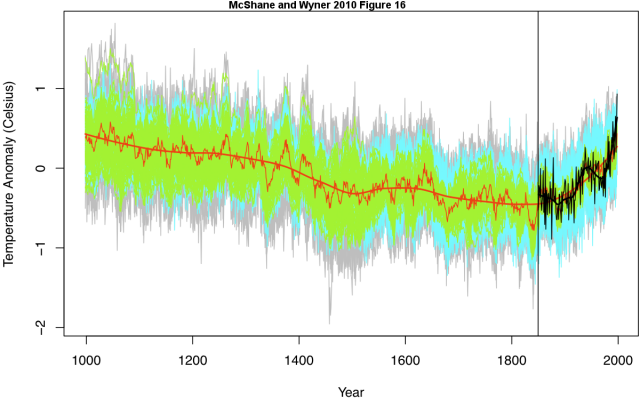
Re: What Does this Graph Mean to You?

As I understand it, this graph is the revision of the famous hockey stick graph. Apparently the algorithm that produced the original hockey stick would create a hockey stick out of any data set. So now we have this graph.

I really don't know enough about statistics or the methodology to say whether this graph is accurate. Lets suppose for a second it is. The red line represents the scientist best guess at earth temperature for the last 1000 years. The gray area represents the margin of error for this measurement.

I think it's interesting how little this graph tells us. You could say the following about the graph, all of which are true:
  1. Data indicate that the earth's temperature has been rising since industrialization.
  2. Data indicate that the earth's temperature will continue to rise.
  3. Data are inconclusive as to temperature trends in the last 1,000 years.
  4. Data are consistent with no change in temperature for the last 1,000 years.
  5. Data are consistent with slight decline in temperature for the last 1,000 years.

WTT 1967 Fender Bandmaster 3 10 W/ road case Combo

WTT 1967 Fender Bandmaster 3 10 W/ road case Combo:

Orange Dual Terror or Tiny terror W/ ex Cab, Vox AC 15 (Heritage) DR. Z, Port City. Or maybe something cool I don't even know about. Must be tube. I am not really looking to sell, and lets face it, its hard to sell anything right now anyway:) so lets make a deal.
I wonder if there is an economic theory to explain this behavior. Money is used to facilitate exchanges among many people. It's going to be hard for this guy to find a person who wants his amp more than the other amps on his list and has that amp to trade. Why is he limiting himself to trades?

Thursday, August 26, 2010

About that Mosque-like Islamic Center

Initially I was very not against this mosque center thing. It seemed like a simple property rights issue. The Muslims own the property? Then they should be able to build. But I kept having this nagging feeling like something is not quite right with it.

Upon reflection, I think I am against it. I still think it's clear that the owners have the property right to put the mosque there, and I don't think those who oppose the mosque should use the government to get what they want. But. . . I think that the people who are building the mosque are using ground zero to be intentionally provocative. Specifically they are intentionally building a mosque by ground zero to "promote inter-community peace, tolerance and understanding locally in New York City, nationally in America and globally.
" In other words, they picked a spot next to ground zero--where American's were slaughtered by Islamic extremists--to launch a program to teach tolerance to the most tolerant nation in the world. It's condescending. And it's bad form to use a tragedy to gin up attention for your project.

The fact that there are other non-controversial mosques located near by, I think, proves my point. My objection is not to Muslims or mosques in the vicinity--its to the intentions and condescensions of these mosque builders.

How Andrew Breitbart Makes James Cameron Look Like an Ass | TheWrap.com

How Andrew Breitbart Makes James Cameron Look Like an Ass | TheWrap.com: "Cameron attended the event on Sunday and used the platform to say of those who question man-made global warming: “I think they are swine.'"

Wednesday, August 25, 2010

Right on This One

Isaac Chotiner writes:
I am a little late coming to this, but yesterday's David Brooks column, which discussed our ability (or inability) to (in Orwell's words) face unpleasant facts, included the following:
The ensuing mental flabbiness is most evident in politics. Many conservatives declare that Barack Obama is a Muslim because it feels so good to say so. Many liberals would never ask themselves why they were so wrong about the surge in Iraq while George Bush was so right. The question is too uncomfortable.
Is Brooks really comparing these two things? A huge percentage of Republicans think that Barack Obama is a Muslim. A huge percentage of Democrats (presumably) think they were right to oppose the surge. In other words, a lot of Republicans have a bizarre, often bigoted, and undeniably wrong opinion on a very simple topic. A lot of Democrats think that a hugely complex, somewhat successful, and still inconclusive policy was right to be opposed. (Let's ignore the question of whether it was smart to oppose the surge based on the evidence people had at the time.)
Chotiner's right, this is a bad analogy. A more apt comparison to 31 percent of Republicans believing that Obama is a Muslim, is 35 percent of Democrats believing Bush had knowledge about the 9/11 attacks in advance. Of course, there is nothing per se wrong with being a Muslim, whereas Democrats inexplicably believe Bush was complicit in the largest terrorist attack on American soil ever.